




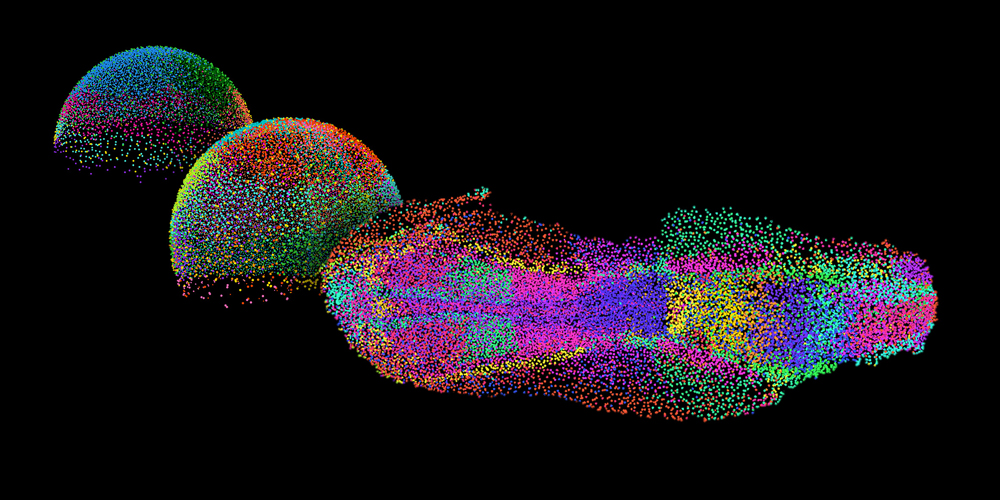
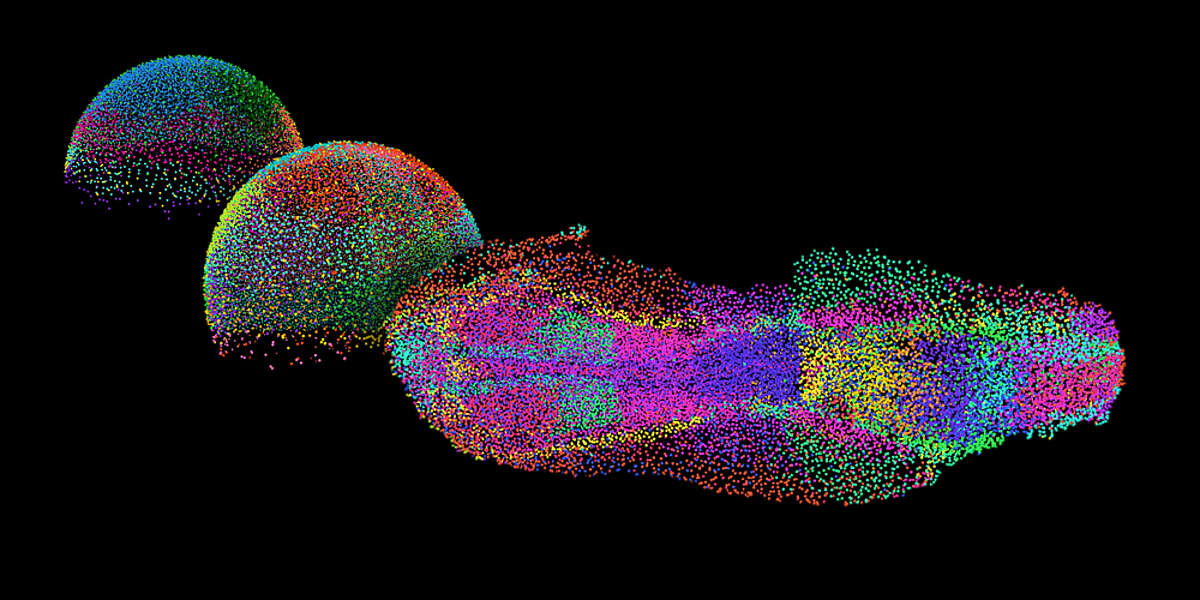
The interplay between genes and cells during the development of a fertilized egg into an embryo is highly complex. Previous methods captured gene activity only in 2D slices, making whole-embryo visualization impossible and offering limited spatial detail, often missing subcellular patterns. The new method now enables the research team of Prof. Alex Schier at the Biozentrum, University of Basel, to visualize the activities of thousands of genes throughout the entire embryo and link them to cell maturation and movement. The result is a comprehensive atlas of early development, along with new insights into how genes and cells shape the growing embryo. The study was published in Science.
A 4D atlas for genes and cells
“A central question has been: How do thousands of genes work together in an embryo, and how is their activity linked to the movement of cells?” says first author Yinan Wan. To answer this question, the team developed a new imaging technology called weMERFISH. It enables the direct measurement of the activity of nearly 500 genes in entire tissues with subcellular resolution.
From these measurements, the researchers created an atlas of early embryonic development. “By combining previous single-cell data with our gene activity measurements, we were able to calculate spatial patterns of thousands of genes and the activity of around 300,000 potential regulatory regions,” says Wan. The data are freely accessible through the web platform MERFISHEYES (http://schier.merfisheyes.com). “The atlas is intended as a resource for developmental biologists around the world.”
When time becomes visible in space
The images provide not just static snapshots but allow conclusions about spatial and temporal processes. For example, during tail formation, the researchers observed that cells along the body axis are arranged in a sequence of developmental stages: at the tip of the tail lie immature stem cells, while farther forward increasingly mature cells, such as muscle cells, can be found. “In a sense, you can see time in space,” explains Wan. “It was also surprising that changes in gene activity align with how cells move through the embryo, linking gene expression dynamics to morphogenetic movements.”