


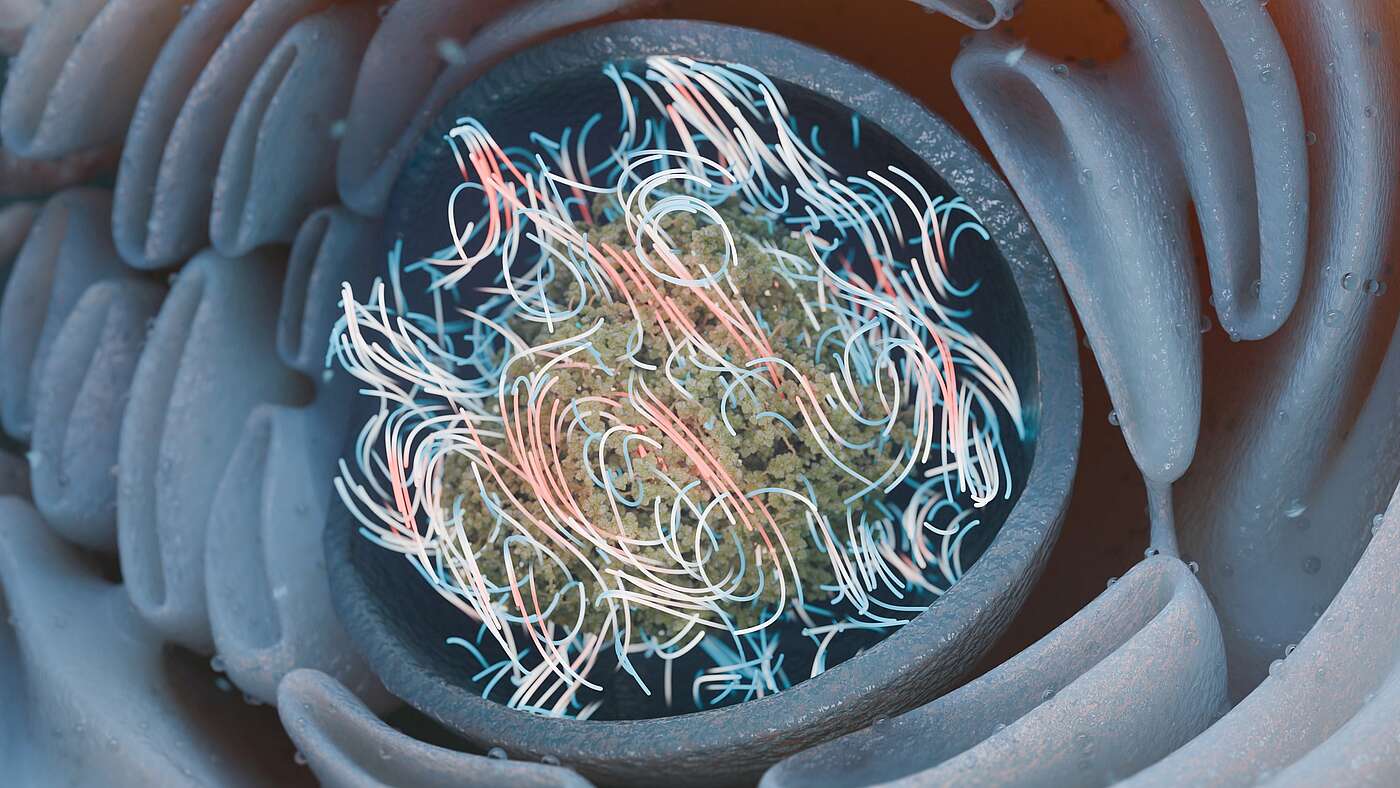
Chromosomes are not rigid structures. Rather, they resemble very long, intricately twisted and folded strands packed densely within the cell nucleus. Their folding and spatial arrangement change, for example, during cell division or DNA repair. Such rearrangements enable regulatory DNA elements to meet and activate their target genes.
Scientists already knew that chromosomes do not sit still inside the cell nucleus. Together with an international research team, physicist Prof. David Brückner has shown that currents within the nucleus govern the motion of individual DNA regions. “Chromosomes are surrounded by a fluid called the nucleoplasm,” says Brückner. “This fluid is not static: it flows, carrying nearby DNA regions along with it.” The researchers also found that these currents influence how long two DNA elements stay together after meeting.
Carried by the same current
Current computer models picture a chromosome as a chain of connected DNA elements, each jostled about by its own random kicks. Two neighboring regions should therefore move largely independently of one another. However, experiments in fruit flies did not support these predictions: the movements of two loci were much more closely linked than these models predicted. To understand this observation, Brückner simulated the dynamics of two DNA elements in flow fields.
Both the simulations and the experiments revealed the same pattern: the closer two elements are in space, the more strongly and for longer they move together. This coupling depends on their physical proximity and not their distance along the DNA strand. “This can be explained by local currents that carry the DNA along,” says Brückner. “It is similar to two leaves floating side by side in water.”
Actively driven currents
The researchers also found that local fluctuations within the nucleus are actively driven, meaning they require energy. “When we deplete the cells’ supply of ATP, their energy source, the effect weakens. DNA regions in close spatial proximity remained together for less time,” says Brückner. The team led by Prof. Luca Giorgetti at the Friedrich Miescher Institute for Biomedical Research (FMI) confirmed this prediction in experiments with mouse embryonic stem cells.
Longer to meet, longer together
Furthermore, the researchers showed that these flow-driven movements create a trade-off: Distant DNA regions encounter each other less frequently, but once they meet, they remain together for longer.
Regulatory DNA elements can often be located very distant on the DNA strand, sometimes even on different chromosomes. How often they meet and how long they remain in contact can influence gene regulation. “Longer contact could give the molecular machinery needed to activate a gene more time to assemble,” says Brückner. “Our work shows how the surrounding environment influences the motion of chromosomes.” Future experiments could reveal the functional implications for gene regulation.
Publication:
Janni Harju, Mattia Ubertini, Deepthi Kailash, Po-Ta Chen, Pierre Ronceray, Luca Giorgetti, Thomas Gregor, David B. Brückner. Chromatin loci move coherently due to spatially correlated fluctuations. Science Advances; published online 18 November 2026
Contact: Communications, Katrin Bühler