



A man of many talents
November 2026
Growing protein crystals, creating a Zen garden, sailing the ocean and collecting plastic samples: Roman Lehner is hard to pin down. The Biozentrum alumnus has worked as a cook, renovated a house and co-founded Sail & Explore. Today, he combines marine research with an entrepreneurial spirit – and already has his next idea in mind.

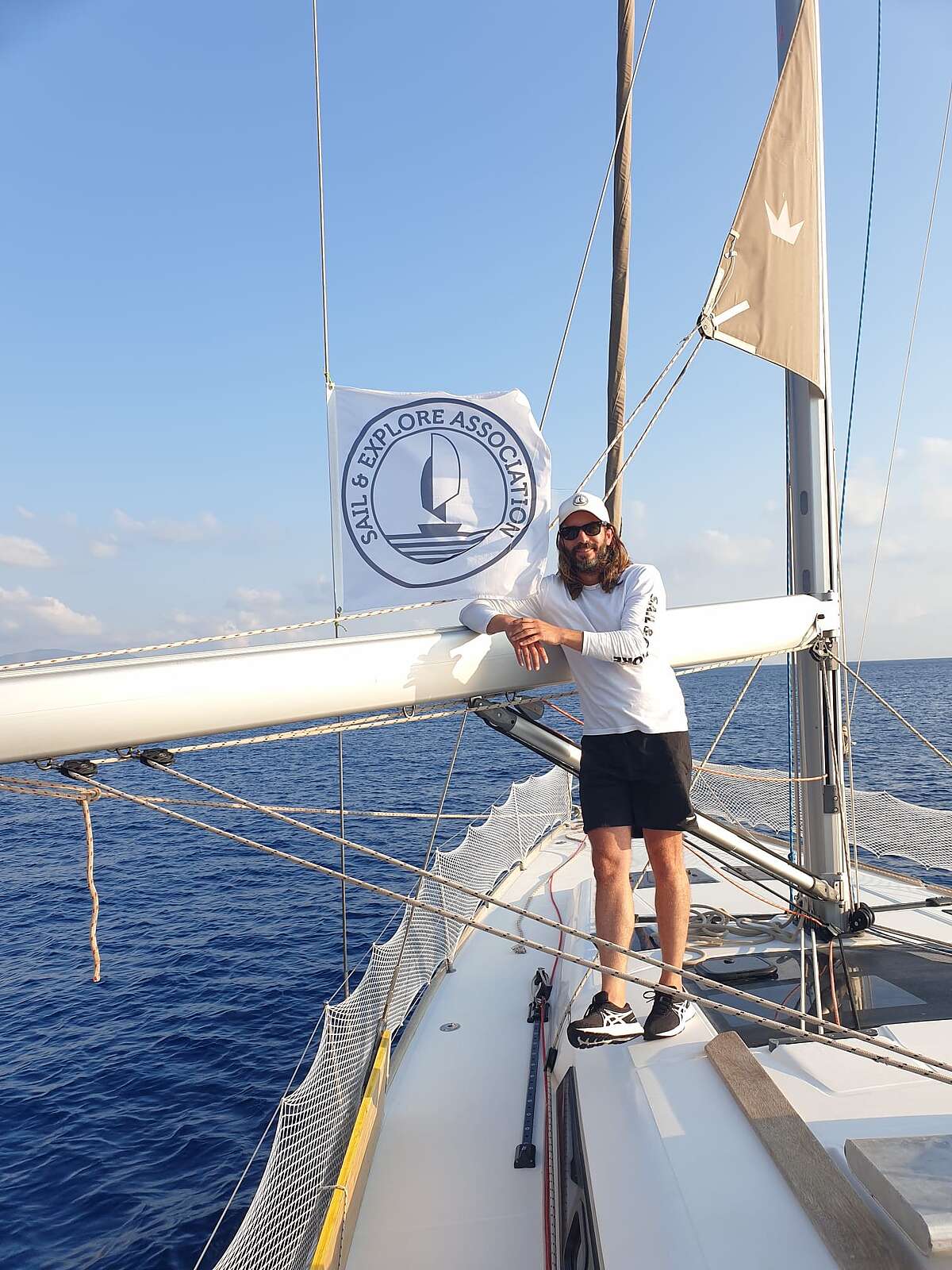
Roman Lehner completed a master’s degree in structural biology at the Biozentrum, University of Basel, and earned a PhD in nanomedicine before turning to micro- and nanoplastics research. Today, he is a principal investigator at the University of Bern, co-founder of Sail & Explore and founder of Dive & Explore, combining marine research, sailing and citizen science to investigate plastic pollution.
You’ve just returned from an expedition. Where did you go?
I was in Boston with Sail & Explore. Among other things, we held a public event as part of a joint project with American marine conservation organisations, Swissnex and the Swiss Consulate. During the expedition, we collected and analysed water samples in the Stellwagen Bank marine sanctuary for the first time, while also training future Ocean Ambassadors. We showed them how marine microplastics research works – from sampling to lab work. When they do lobbying work later on, they need to know what they’re talking about.
Where are we more likely to find you these days: on a sailing boat or in the lab?
I’m mostly in the lab and the office and tend to work behind the scenes. I used to spend a lot of time on the boat. I’ve led more than 25 research expeditions. It’s wonderful, and we’ve had a lot of cool projects that have taken me as far as Samoa. But being away also holds up the other projects that are still ongoing. With Sail & Explore, I actually only lead exotic expeditions now. Otherwise, I focus on analysing samples and getting new projects off the ground. Next year, for example, I’ll be joining an expedition to the Maldives, where we’re starting a new project. At the same time, I’m leading a research project at the University of Bern and setting up a start-up.
It all started with a sheep. What did Dolly have to do with your choice of study?
When Dolly was cloned, I was just finishing high school. Genetics wasn’t really part of our biology classes back then. But I found it incredibly exciting and started thinking about where I could study it. So I wasn’t that little boy who’d always wanted to be a scientist. I was much more into skateboarding, punk and concerts. I wasn’t a model student either. I got kicked out of school and then worked in a factory, testing the coating on espresso capsules. That made me realize how privileged you are if you can choose your own path. I went back and finished high school later.
And then you studied at the Biozentrum. How did that happen, since you’re originally from St. Gallen?
After finishing school, I first went on a big trip to Australia. Much to my parents’ dismay. Having already been kicked out of school, I think they were worried I’d never go to university. But I came back from that trip really motivated. Back then, I met up with lots of people, and a friend told me about the Biozentrum. She’d started studying there. I checked it out and thought, “Hey, this could be a good fit.”
So did you end up going into genetics?
No, even though Walter Gehring was my academic mentor and encouraged me to go in that direction. He saw the enormous potential of those methods. I admired him both as a scientist and as a person. I also joined his marine biology field trips to Banyuls-sur-Mer and helped out with the courses. But structural biology appealed to me much more. You produce a protein, grow crystals and eventually get to see what its structure looks like. I’m a visual person, so that really suited me. And that’s how I ended up doing my master’s with Tilmann Schirmer. That training has given me an incredibly solid foundation.
Still, you wanted to leave the university after your master’s, …
Yes, I felt I’d had enough of the academic world. And I didn’t actually want to do a PhD. I’d always been very creative, and I thought research wouldn’t give me enough room for that. But I had to earn money somehow, so I started working at the Institute of Anatomy. Shortly afterwards, I saw that a PhD position in nanomedicine was posted at the University Hospital. The project focused on vesicles for drug delivery and involved membrane proteins. That was something where I could use my background in structural biology. The combination of research and medicine immediately caught my interest.
In the middle of your PhD, you built a huge Zen garden. How did you come up with this idea?
I’d always been very involved in Basel’s art scene. Together with a friend, I had been creating urban Zen gardens in public spaces. At an event, I happened to sit next to a member of Basel’s cantonal parliament and told him about our idea for a huge Zen garden. He put us in touch with the public works department. And then trucks turned up with 800 tonnes of gravel. And there we were, with long hair, espadrilles and shovels. We created this enormous installation in front of the Novartis Campus. That was in 2013, during Art Basel. I’ve always lived in different worlds at the same time.
After your PhD, you headed to the kitchen instead of the lab.
Yes, I worked as a cook at the Landestelle. The plan was to go to Japan afterwards and open a bar with a buddy from Tokyo. But, as happens in life, things turned out a little differently. I became a father, so that idea was put on hold for a while. Later, I spent two years helping a friend renovate his house. Tearing out floors, getting stuck in, seeing what you’ve actually done: that felt good. After my Master’s, PhD and later on too, I’ve always needed to do something different every now and then.

How did you eventually end up in marine research and working on plastic pollution?
Again, through connections. A friend brought me into the non-profit organization OceanCare. As a scientific guide, I counted dolphins and sperm whales from a boat in the Mediterranean. That’s also where I met my future co-founder of Sail & Explore. Through OceanCare, I was also asked to take part in a documentary about plastic in the ocean. We set off from Bali on a sailing boat, showing the plastic pollution in the sea and on the islands, and also that we have the same problem in Switzerland. Afterwards, the Swiss Embassy invited me to an event in Rio de Janeiro to give a talk on plastic pollution. That was where I first came into contact with Swissnex. During the event, I realized that, with my scientific background, I could venture into a completely new field and explore the question: “What are the potential effects of microplastics on human health?”
And from then on, you were hooked?
Back then, everyone was talking about microplastics. And I kept wondering: why aren’t you looking at the even smaller particles – microplastics smaller than 0.3 millimetres, or nanoparticles? From nanomedicine, I knew that size can be crucial in determining whether cells take up particles. Suddenly, environmental issues, health and my own expertise all came together. I found that incredibly exciting. I took the idea to the Adolphe Merkle Institute in Fribourg, which works on bio-inspired nanomaterials. There, among other things, we built a 3D gut model using human intestinal and immune cells to investigate possible negative effects of microplastics. And we developed methods for producing nanoplastic particles as reference materials.
And why did you found Sail & Explore?
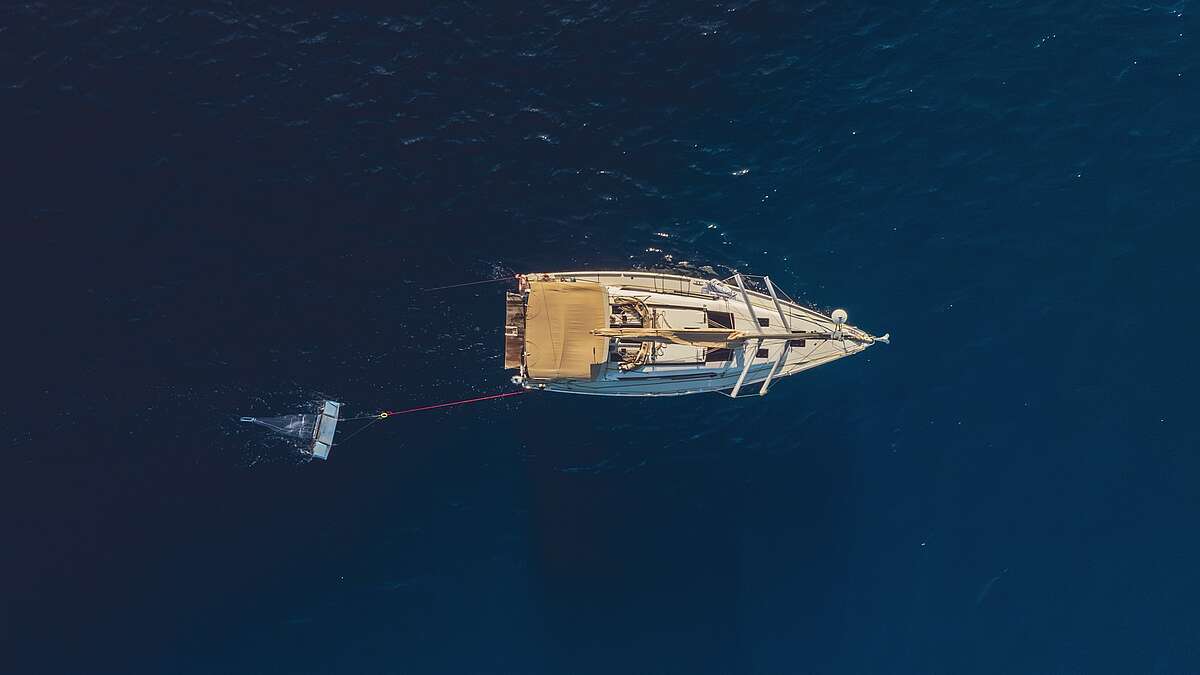
I wanted to understand for myself how data is collected at sea. So my friend, who’s a passionate sailor, and I said, “Let’s do it!” In 2018, we organized our first expedition from Genoa to Sardinia and back. At the time, we borrowed the sampling equipment – a manta trawl – from the marine researcher Marcus Eriksen, whom I’d met before. Since then, we’ve started building our own research equipment, because the devices generally used are quite limited in terms of handling and application.
So, Sail & Explore grew out of that initiative?
Yes, that’s how it all started. Today, we work in places including the Mediterranean, the US West and East Coasts, the Azores and the Great Barrier Reef. And next year, we’re adding the Maldives. Long-term studies are particularly important to us because taking samples repeatedly at the same locations allows us to track changes. Our focus is on “invisible” microplastics. No one else in the world is carrying out this kind of microplastics monitoring.
Where does your data go?
We publish our data in scientific journals and share it with the US National Oceanic and Atmospheric Administration, NOAA, and the European Marine Observation and Data Network, EMODnet. It’s important to us that the data we collect is visible and accessible so other people can use it.
Can people join your expeditions?
Yes, anyone can join us. What makes it special is that you’re part of the crew: you steer the boat, learn to sail and help with sample collection. There are also lectures on different topics, and you get the chance to meet local researchers. Participation fees help cover the costs, but we also need to raise funding and find partners and sponsors. Marine science students can apply to us for a scholarship too. Working with local research institutes wherever possible is also important to us. On the Azores island of Faial, we’ve been working closely with researchers from OKEANOS for a long time.

A research group at the University of Bern, Sail & Explore – surely that’s enough to keep you busy?
Well, two years ago I founded Dive & Explore. We organize diving expeditions that combine marine research with diving. But right now, most of my energy is going into launching a spin-off. Using my methods, I can produce nanoplastics from packaging materials, such as Rivella or Coke bottles. These reference materials help develop analytical methods for quality control in food and pharmaceutical products. It’s still a huge challenge to reliably identify the tiny plastic particles in a sample.
Is your goal a world without plastic?
No. I’m not against plastic per se, and I don’t live a plastic-free life either. The material has lots of advantages, and it’s not going to disappear from our planet. What matters is how we handle it. I want to work with people and companies to develop solutions, create a space – a momentum - for discussion and get things moving.
For more information about expeditions, workshops and dates, visit Sail & Explore and Dive & Explore.
